The One stop to find out about Polynesians in sports at the amateur, high school, collegiate and professional levels and much more.
Thursday, July 19, 2012
Vikings | Matt Asiata is dark horse candidate
Posted: 6 hrs 59 mins ago. | Source footballguys
Minnesota Vikings RB Matt Asiata catches the ball well enough to draw the attention of coaches, and he might get a chance to carry the ball in his second camp with the team. He has a chance to win a job, but there is plenty of competition at the position.
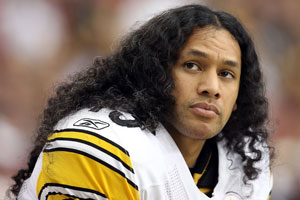
Troy Polamalu said he has lied about sustaining concussions to get back into an NFL game.
(Christian Petersen/Getty Images)
Pittsburgh Steelers safety Troy Polamalu revealed on Wednesday’s Dan Patrick Show that he has lied about sustaining concussions as an NFL player to get back into a game, and said playing a “tough man’s game” is what makes it so popular.
In response to Patrick asking him whether he has lied to get back into a game, Polamalu said:
“Yes I have,” Polamalu said. “There’s so much built up about team camaraderie and sacrifice and football is such a tough mans game. I think that’s why it’s so popular. That’s why so many blue collar communities and people can really feel attracted to this because it is a blue collar struggle that football players go through.”
He said that the idea is to “just push yourself to be out there with your brothers.” He estimates having suffered eight or nine concussions throughout his career, and he expects the number will be higher by the time he retires. If players count every little “buzz” as a concussion, he said, the number would more likely be 50 to 100.
The NFL schedule is grueling, he said, and there’s a pressure to play every week despite perhaps being legitimately injured:
“You feel sore, you’re beat up, you’re injured, you’re legitimately injured, most people may take three months off to work in an office, we choose to play the next week.”
He said that while he has no doubt lied about suffering head injuries so that he wouldn’t have to miss playing time, in cases where the concussion is severe, “you can’t even be conscious enough to lie.”
Concussions have long been an issue for the NFL, but it is an especially sensitive topic now for the league given the recent scandal involving the New Orleans Saints’ bounty program.
Wednesday, July 18, 2012
College Football Awards 2012: Manti Te’o Named To Butkus Watch List
Notre Dame Fighting Irish linebacker Manti Te’o is widely regarded as one of the best linebackers in college football, so it’s no surprise that he has been named to the 2012 Butkus Award Watch List. In 13 games last season, Te’o tallied 128 tackles, which was tied for No. 16 overall in the country. Te’o also had 13.5 tackles for loss, five sacks and a forced fumble.
Northwestern Wildcats linebacker David Nwabuisi was also named to the watch list. As a junior in 2011, he totaled 84 tackles, with 8.5 of those going for loss. He also had a sack and two forced fumbles. Jonathan Brown of the Illinois Fighting Illini was tabbed as well. As a sophomore last season, Brown amassed 108 tackles, with 19.5 going for loss. He also picked up six sacks, a forced fumble, an interception and a fumble recovery.
— SB Nation
Sunday, July 15, 2012
Chris Owusu Can Become a Star
With the 49ers' recent additions of Randy Moss, Mario Manningham and A.J Jenkins to the wide receiver group that already features Michael Crabtree and Kyle Williams, you can be forgiven for allowing Chris Owusu to slip your mind.
I fully expect Moss, Manningham, Jenkins, Crabtree and Williams to make the final roster, but I'm really hoping the team takes a sixth wide receiver in the shape of Owusu.
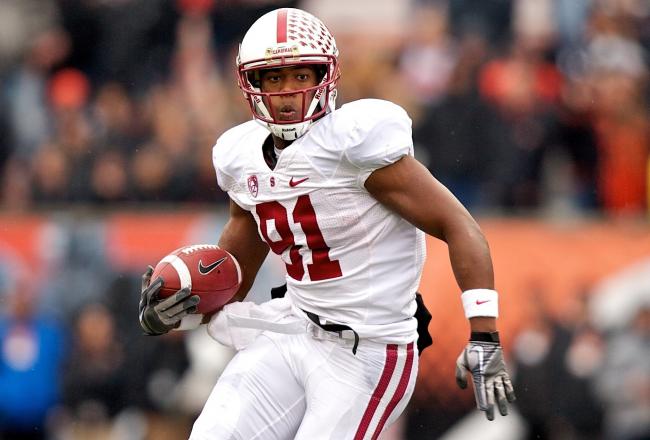
Coached by Jim Harbaugh at Stanford, Owusu could have been a pretty high draft selection had it not been for worrying concussion issues.
Now, I'm all for Owusu spending a year on the practice squad if he isn't healthy, but if he is fully fit, I want him to be a major weapon for the team.
Whether he contributes as a receiver or return man, I just want another elite athlete on offense who can go deep and create some magic.
Some may say that Ted Ginn fills that role, but I see him as more of a full-time return man who can be a gadget type of player when needed.
Owusu will have little trouble in understanding the system of the San Francisco 49ers; I'm not saying it will be easy, but he did master one of the most complex offenses in college football with Harbaugh at Stanford.
Ty Montgomery is the new star wide receiver at Stanford and the biggest praise he has been given is that he is thought of by many as the "new" Chris Owusu.
Owusu's physical attributes are incredible too; pure 4.3 speed with a 40"-plus vertical to match.
He may be seen as a speed merchant, but a 6'0", near 200-pound frame who can bench press 225 pounds 19 times has plenty of strength to cope with physical corners in the NFL.
The thing to admire most about Owusu is that he reaches his top gear straight away and doesn't slow down until he completes his route. He can also go up and get the ball at its highest point in a similar fashion to a receiver much taller than he is.
He is a big play waiting to happen and he also is less raw in the route-running department than many receivers who were actually drafted in the 2012 NFL Draft.
That being said, he did miss seven games in 2010, some more in 2011 and suffered three concussions in just over a year.
To me, Owusu is a future starter in the NFL if he can stay injury-free because he has blistering speed, strength to beat the press, good route-running and a good pedigree from his time at Stanford.
A three-year starter in college, I really hope Owusu can have a long career with the 49ers in which he can showcase just how dynamic a talent he is.
What do you guys think?
I fully expect Moss, Manningham, Jenkins, Crabtree and Williams to make the final roster, but I'm really hoping the team takes a sixth wide receiver in the shape of Owusu.
Coached by Jim Harbaugh at Stanford, Owusu could have been a pretty high draft selection had it not been for worrying concussion issues.
Now, I'm all for Owusu spending a year on the practice squad if he isn't healthy, but if he is fully fit, I want him to be a major weapon for the team.
Whether he contributes as a receiver or return man, I just want another elite athlete on offense who can go deep and create some magic.
Some may say that Ted Ginn fills that role, but I see him as more of a full-time return man who can be a gadget type of player when needed.
Owusu will have little trouble in understanding the system of the San Francisco 49ers; I'm not saying it will be easy, but he did master one of the most complex offenses in college football with Harbaugh at Stanford.
Ty Montgomery is the new star wide receiver at Stanford and the biggest praise he has been given is that he is thought of by many as the "new" Chris Owusu.
Owusu's physical attributes are incredible too; pure 4.3 speed with a 40"-plus vertical to match.
He may be seen as a speed merchant, but a 6'0", near 200-pound frame who can bench press 225 pounds 19 times has plenty of strength to cope with physical corners in the NFL.
The thing to admire most about Owusu is that he reaches his top gear straight away and doesn't slow down until he completes his route. He can also go up and get the ball at its highest point in a similar fashion to a receiver much taller than he is.
He is a big play waiting to happen and he also is less raw in the route-running department than many receivers who were actually drafted in the 2012 NFL Draft.
That being said, he did miss seven games in 2010, some more in 2011 and suffered three concussions in just over a year.
To me, Owusu is a future starter in the NFL if he can stay injury-free because he has blistering speed, strength to beat the press, good route-running and a good pedigree from his time at Stanford.
A three-year starter in college, I really hope Owusu can have a long career with the 49ers in which he can showcase just how dynamic a talent he is.
What do you guys think?
Troy Polamalu wins appeal on $10K mobile phone fine
Way in October, Steelers safety Troy Polamalu was penalized $10,000 for speaking on his mobile phone throughout a game title. Polamalu was on the telephone together with his wife, declaring that was OK health-smart, and that's why Steelers coach Mike Tomlin thought the security should not be penalized.
The National football league did not care, and penalized Polamalu anyway. But happy news today as Jason LaCanfora from the National football league Network reviews that Polamalu won his benefit of the fine and was informed of his win through the league on Thursday.
Based on league rules, using electronics around the sideline (or, within the bench area, should you prefer) is against the law as much as 1 hour 30 minutes before games before the finish of game. (It's why gamers can't tweet throughout games either.)
Clearly Polamalu's communication together with his wife was dependent on notifying her he was physically safe therefore the league is supplying the best towards the rule here. There's some argument that permitting this kind of exception could create a simple excuse for gamers who wish to use electronics around the sideline.
A couple of issues with that logic: there needs to be some concern for the sake of someone who really wants to use electronics for your excuse to use. Polamalu was penalized anyway, therefore the player under consideration may likely need proof that the emergency contact/immediate member of the family was known as/texted/tweeted. And lastly, the benefit of utilizing a mobile phone around the sidelines is fairly minimal.
Everything being stated, the league could be wise to create something similar to this prior to the competition committee within the offseason and see wherein a team by having an hurt player can offer a reminder to family people who aren't at the overall game and can be worried about the healthiness of the gamer under consideration.
Friday, July 13, 2012
LB Manti Te'o earned recognition on the Bednarik Award Watch List.
Te'o (Laie, Hawaii/Punahou H.S.) led the Irish with 128 tackles, 13.5 tackles for loss and five sacks in 2011. He has collected 261 combined tackles over the last two seasons. Te'o became the 10th player in Notre Dame history to record 300 tackles for a career and currently ranks eighth in school history with 324 tackles.
Walter Camp, Rivals, Phil Steele, SI.com and Associated Press named Te'o a second-team All-American. He earned Capital One Academic All-America second-team honors last year. Te'o was also a finalist for the Butkus Award and Lott Trophy in 2011.
Lofa Tatupu contract details out, better than we thought.
It's a two year deal. Broken down as such:
$600,000 signing bonus, so $300,000 cap hit per year.
2012 base - $750,000
2013 base - $1,000,000 but will turn into $2,250,000 if he hits playing time incentives.
In terms of LTBE incentives for 2012, there isn't a single one. However, Tatupu can make $40,625 per game if he is active this season. For a max of $650,000 that would turn into LTBE incentives for 2013.
Cap Hits:
2012 - $1,050,000
2013 - $1,300,000 if he plays all 16 it turns into $3,200,000 as he would surely hit all PT incentives for the bigger bonus.
http://espn.go.com/blog/nfcsouth/post/_/id/36463/around-the-nfc-south-325
So essentially this:
Year 1 - $750,000 salary + $300,000 Signing Bonus = $1.050 M cap hit
Year 2 - $1.000 M salary + $300,000 Signing Bonus = $1.300 M cap hit
OR - $2.25M salary + $650k incentives + $300k Signing bonus = $3.200 M cap hit.
So while Tatupu can legitimately make up to 4.9M in his deal, a maximum of 4.25 can hit the cap and this year just 1.050 will hit the cap.
$600,000 signing bonus, so $300,000 cap hit per year.
2012 base - $750,000
2013 base - $1,000,000 but will turn into $2,250,000 if he hits playing time incentives.
In terms of LTBE incentives for 2012, there isn't a single one. However, Tatupu can make $40,625 per game if he is active this season. For a max of $650,000 that would turn into LTBE incentives for 2013.
Cap Hits:
2012 - $1,050,000
2013 - $1,300,000 if he plays all 16 it turns into $3,200,000 as he would surely hit all PT incentives for the bigger bonus.
http://espn.go.com/blog/nfcsouth/post/_/id/36463/around-the-nfc-south-325
So essentially this:
Year 1 - $750,000 salary + $300,000 Signing Bonus = $1.050 M cap hit
Year 2 - $1.000 M salary + $300,000 Signing Bonus = $1.300 M cap hit
OR - $2.25M salary + $650k incentives + $300k Signing bonus = $3.200 M cap hit.
So while Tatupu can legitimately make up to 4.9M in his deal, a maximum of 4.25 can hit the cap and this year just 1.050 will hit the cap.
Matured Paul Soliai plays key role in Miami Dolphins’ defense
Defensive lineman Paul Soliai has matured during his time with Miami and has developed into ‘the anchor’ of the Dolphins’ defense.
BY DAVID J.NEAL
dneal@MiamiHerald.com
The NFL’s evolution into a pass-first league changes nothing in that NFL defense starts up front (ask New England why the Giants have two Super Bowl rings the Patriots don’t). So the continued progress of the Dolphins defense this season begins with the two current longest continuous serving members of the Dolphins defense.
And one of them says the other is “the anchor of our defense.”
“If he doesn’t play well, we have no defense,” defensive tackle Randy Starks said of nose guard/defensive tackle Paul Soliai.
Neither one’s effectiveness can be seen in the standard statistics. Starks earned a Pro Bowl berth as an alternate in 2010 despite his sacks dropping from 7.0 in 2009 to 3.0 and tackles dropping from 56 to 30.
You have to actually see blockers occupied, running plays disrupted or quarterbacks influenced into sacks or turnovers. While edge rushers get the sexy blindside bashes and the big sack totals, the pressure that truly discomforts quarterbacks comes rumbling up the middle. Being unable to step up in the pocket often leads to throws without feet being set, which often lack enough steam or accuracy.
Soliai, 6-4, 355, is better at taking up blockers in the run game than getting a pass rush — he didn’t have a single sack in 2011 — but the Dolphins didn’t keep him to be a specialist in the lesser part of modern offenses. After making $12.5 million as the Dolphins franchise player in 2011, Soliai re-signed a two-year deal worth $8.15 million in base salary rather than truly explore free agency.
“I left it all up to my agent [David Canter],” Soliai said. “I took the offseason to spend time with my family. I really didn’t get to think about it until my agent gave me a call to tell me who wanted to talk to me. I just wanted to have fun with my family.
“I wanted to stay,” he continued. “That’s my main goal was to stay here. I started here. I started slow. I like how I’m going right now, I’m going well.”
Back in 2008, it seemed ludicrous to think either Starks or Soliai would still be Dolphins in 2012.
Tennessee, which had a track record of knowing when to let defensive linemen go, didn’t prevent Starks from leaving as an unrestricted free agent. Soliai got into only eight games as a rookie in 2007.
It took Soliai time to figure out a few things after going from college to the NFL: professionalism, fitness, the nuances of the thankless nose guard position.
As a rookie, he reported overweight because he thought he needed it.
His second year saw less weight, more playing time, but two one-game suspensions for violations of team policy.
Jason Ferguson’s retirement after two seasons starting at nose tackle and Soliai’s slow improvement prompted a plan to move Starks to nose guard in 2010. That got scrapped when Soliai got good.
“I’ve grown up a lot,” he said. “Stuff I did the first and second year … I’m more responsible, more accountable. A lot of my teammates look to me now. I’m just trying to be a leader.”
Starks said, “I’ve seen him grow as a person and a player. We watch film more together [now]. When I first got here, he was kind of quiet. I didn’t know what he was thinking. Maybe he was just following Ferguson’s role. Now, he’s taken over the role of nose tackle.”
The now-veteran Soliai didn’t take long to figure out his role in the Dolphins new defense.
“It’s basically the same as last year,” he said. “Last year, we ran a lot of 4-3. But we’re more aggressive this year, so that’s a good thing.”
Starks said he’ll be playing more “three technique” lining up between the guard and tackle.
“It’s going to put pressure on me to get a pass rush, help [outside linebacker] Cam [Wake] out,” he said. “At the same time, I’m looking forward to that challenge.
“I feel like I’m more comfortable in the position. I know where I’m going to be playing. It gives me a chance to get used to it and perfect the position. In the 3-4, I might be head up [over the center], might be over the tackle, might be over the guard.”
Starks’ 2011 season ended with a spectacular game against the Jets: a sack and the first two-interception game by a defensive lineman in Dolphins history.
Overall, however, he said, “I thought I did OK. I’m capable of doing more. I’ve proven that in the past. I think this year, I need to play to the level I did three years ago.”
San Francisco 49ers NT Isaac Sopoaga Deserves a Bumper New Contract After 2012
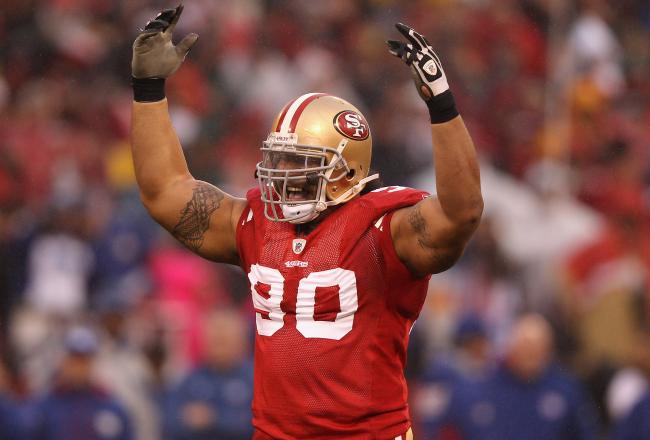
Justin Smith, Patrick Willis and NaVorro Bowman get all the headlines, but Isaac Sopoaga is the cornerstone of the San Francisco 49ers defense. The veteran nose tackle deserves a lucrative new contract after his current deal expires at the end of the 2012 season.
The unheralded nine-year pro made the switch to nose tackle in 2011 and quickly became one of the league's best at the position. Moving Sopoaga over the center helped turn an already-talented defense into a truly formidable unit.
At 6'2", 330 pounds, Sopoaga has the powerful frame and natural leverage to occupy double-teams and push the pocket. With Sopoaga holding the middle, Justin Smith is allowed to spend more time rushing the passer than most 3-4 linemen enjoy.
Bowman and Willis both benefit from clear lanes of pursuit thanks to Sopoaga's ability to handle 2-gap responsibilities. He was the fulcrum of a run defense that went 14 games without yielding a touchdown in 2011.
There are more high-profile nose tackles in the NFC—Dallas Cowboys' playmaker Jay Ratliff and Green Bay Packers' youngster B.J. Raji—but none can match Sopoaga's ability to be a force in the middle.
Sopoaga turns 31 in September, but nose tackles tend to get better with age. New England Patriots' star Vince Wilfork and Pittsburgh Steelers' stalwart Casey Hampton are prime examples.
There is every reason to believe Sopoaga will do the same. He has improved each season since becoming a regular starter in 2008. The move to nose tackle is likely to add another couple of years to his career.
The New York Jets showed that age is no barrier in recognising the importance of a dominant nose tackle. They gave a three-year, $15 million deal to 33-year-old Sione Pouha.
Pure 2-gappers in the middle aren't easy to find at the pro level. If Sopoaga enjoys another stellar campaign this season, then he should be rewarded with a lucrative, long-term contract.
Monday, July 9, 2012
Subscribe to:
Posts (Atom)