Wednesday, March 28, 2012

WSU line coach Salave’a has come long way


PULLMAN – The van cruised down Interstate 5 toward San Diego. And toward the unknown for Joe Salave’a, a ninth-grader at the time, who was still trying to grasp just exactly what was happening.

Salave’a and his youth baseball team were in town from American Samoa for a tournament. But instead of returning home with his friends, a woman flagged him down in the airport terminal.

“She told me, ‘I talked to your dad, you’re going to stay with me and you’re going to go to school here in Oceanside,’ ” said Salave’a, Washington State’s new defensive line coach, in his office on Tuesday. “I was like, ‘What the?’ ”

Never mind that Salave’a had never formally met the woman, who was a family relative. Or that he didn’t know a great deal of English. It was decided that the youngster from Leone, American Samoa, would attend high school in Oceanside, Calif., a suburb of nearby San Diego.

That was a lot to take in for a kid who thought he was just going to play some baseball.

“At the time, it didn’t make sense to me,” Salave’a said.

No more translators in school. He’d have to pick up the language on his own. No more mom and dad to look after him, either.

Salave’a had to grow up fast.

“But I think I would never have gotten this far if I didn’t come across to go to school here on the mainland,” he said.

This far is an assistant coach position under Mike Leach. This far meant a nine-year NFL career.

But Salave’a, a hulking former defensive tackle who played his college ball at Arizona and coached there the last two seasons, really lights up when he talks about the work he’s still doing back home.

The Joe Salave’a Foundation was created in 2001. Ever since, Salave’a, who credits his wife, Josephine, for helping him get it started, has been hosting free youth football clinics in Hawaii and American Samoa.

The camps focus on football, but Salave’a goes out of his way to emphasize academics, to prove to the kids in attendance – some of whom don’t even own shoes – that there are other avenues to success besides football. Or the military, which Salave’a said many kids view as their ticket elsewhere.

One year, Salave’a brought in a Samoan native who worked for the Drug Enforcement Agency. The kids ooed and ahhed as he flashed his badge.

“Football’s not everything,” Salave’a tells them. “But with education, you can be a doctor, you can be a policeman, you can be all kinds of things.

“I’ve always said going into these things if I can get one kid or two to kind of make an imprint in their thinking process, as far as what you want to aspire to, then I think it’s all worth it.”

He’s moved by a desire to “pay it forward,” eternally grateful for the opportunity provided by Arizona when the school offered him a scholarship out of high school, wanting the same for other Samoan players who weren’t as fortunate as he was growing up.

“Hopefully, that will be the start of a thinking process, getting the wheels turned as far as, ‘What do I want to do when I grow up?’ ” Salave’a said. “Because sometimes on the island, you’re subjected to not having those kinds of dreams and aspirations. It paid dividends for me and I’ll always do those kind of things for the younger kids.”

He didn’t know Leach prior to working at WSU, though the two were connected by chief of staff Dave Emerick, who worked with Salave’a at Arizona.

Salave’a’s background led to an interest in how Leach does things.

“I’m always a fan of people that do great things with their resources and what they have, and I think that’s why you tend to gravitate toward those kind of players,” said Salave’a, who will recruit San Diego and American Samoa at WSU. “I think with Mike Leach being here at WSU, his wealth of knowledge and the body of work, I was really intrigued and happy as heck to be a part of that.”

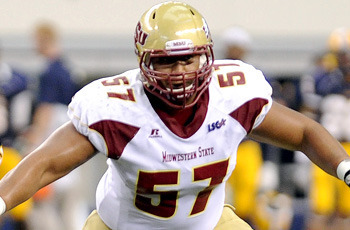
2012 NFL Draft Prospect Profile: Amini Silatolu, OG, Midwestern State


There are always a few small-school NFL Draft prospects you may never have heard of or seen on your television on Saturday afternoons in the fall, but who find the eye of NFL scouts nonetheless. One of the most intriguing prospect in that category for 2012 is Amini Silatolu, a 6-foot-3, 312-pound offensive guard from someplace called Midwestern State.

When I went looking for scouting reports on Silatolu, they all said pretty much the same thing. The one from Wes Bunting of the National Football Post was typical:

"He has some technique flaws that needs to be fixed and will need to kick inside at the next level. However, he's a wide-bodied athlete with a powerful/explosive frame, good foot quickness and can really pull from the backside. Might need some time, but is one of the top guards in the class with as much upside as any."

There’s no denying that Amini Silatolu has the size, strength and upside to be drafted, but it’s all about him being in the right system with the right coaches who can improve his mobility and technique for him to develop into a professional player.

A preseason Division II first-team All-American, the 6’3”, 325-pound Silatolu is in his third year as a starter at Midwestern State and has primarily played left tackle.

But, while he’s experienced in handling pass rushers off the edge, his skill set and footwork are best suited to play guard at the next level.

Silatolu could receive mid-round attention next April.

Bengals Defensive Line Coach Scouting Vaughn Meatoga At Hawaii Pro Day by Josh Kirkendall on Mar 6, 2012 11:38 AM EST in NFL Draft


According to Rob Rang, a senior analyst with NFL Draft Scout (partner with CBS Sports), Cincinnati's defensive line coach Jay Hayes was at Hawaii's Pro Day, scouting defensive tackle Vaughn Meatoga.

Of Hawaii's players, defensive tackle Vaughn Meatoga was not surprisingly the most impressive prospect. The 6-1, 299-pounder is the 22nd-rated defensive tackle in the 2012 class. He was invited to the Scouting Combine, and stood by those numbers, largely sitting out Monday's agility drills. He did participate in the vertical jump (31") and broad jump (9'2") Monday. He lifted the 225-pound bench press 27 times in Indianapolis, ran a 5.00-second 40-yard dash and was fifth among all defensive linemen with a 4.21-second short shuttle.

According to a source close to Meatoga, two NFL defensive line coaches (Kansas City, Cincinnati) came to the workout to specifically see Meatoga. Meatoga dined Sunday evening with the Kansas City coach.

According to Scout, Inc. Meatoga ranks as the 22nd-best defensive tackle prospect.

Hebron Fangupo: Huge Reason For Success


He didn’t even want to play football.

The 6-foot-1, 331 pound, senior defensive lineman from Santa Ana, Calif., never would have stepped onto a football field without the strong encouragement he received from his mother.

In fact, Hebron Fangupo, or Loni as he is known by friends and family, only played one year of high school football.

“I came from the islands,” Fangupo said. “Halfway through my senior year of high school I got to play some football and told my mom I didn’t like it.”

After high school, Fangupo was extremely excited to serve a mission for The Church of Jesus Christ of Latter-Day Saints. During the year in between high school and a mission, Loni went back to the islands to help his father with work and save up for his mission. Fangupo served in the Philippines Manila Mission and upon his return was again encouraged by his mother to pursue football.

Through connections with a family member, Fangupo was able to contact the coaches at a local junior college, Mount San Antonio College (Mt. SAC). He was put on the team and despite his limited experience, Fangupo thrived and was named to the All-Mission Conference first team in 2007. The following year he was a SuperPrep JUCO 100 and named to the All-Central Conference second team. After such a successful stint in junior college, many Division I schools came knocking on Hebron’s door.

One of the many schools that recruited Fangupo was Brigham Young University.

“BYU recruited me and I told my mom I was really interested in BYU,” Fangupo said. “Being a returned missionary I appreciated that I was surrounded by temples and church. But, I prayed and fasted and the Lord told me there was somewhere else I needed to go.”

Fangupo continued to try and decide what school would be the best fit for him. A friend suggested he look into the University of Southern California. Although the list of schools interested in him was long, Fangupo had never been recruited by the Trojans. So Loni decided to take matters into his own hands.

As the story is told, Fangupo went to a USC practice and jumped the 10-foot wall surrounding the practice facility and crossed the field to go and talk with defensive coordinator Nick Holt.

“I jumped down and I looked at Coach Holt,” Fangupo said. “They had a player who was a senior who was going to the league (NFL), and I told him I’m here to replace Fili (Moala). I just told him straight up. He kind of brushed me off and I grabbed him by the arm and I said, ‘I’m the man,’ and he said, ‘Well, if you come in you have big shoes to fill,’ and I said, ‘Well, I have big feet.’ “

The next day Holt and a few other coaches came to watch Fangupo practice at Mt. SAC and were impressed with what they saw. The following day Fangupo received a phone call offering him a full-ride scholarship to USC.

Fangupo accepted the offer and called to tell BYU he would not be suiting up in the blue and white.

“I went to USC and met some great people there,” Fangupo said. “I played a lot but then got hurt and broke my ankles.”

There were many experiences unique to USC of which Fangupo was able to be a part. The team was regularly visited by celebrities including Snoop Dogg, Magic Johnson and especially Will Ferrell.

“Will Ferrell came every time,” Fangupo said. “He would call me by name. I remember at OSU he had a nice suit on and next thing I knew he had his shirt off with a Trojan painted on his chest. I was like, ‘How did you get there?’”

As a consequence of the environment at USC, Fangupo was given the opportunity to share his religious beliefs often with teammates. The unique differences in the way Fangupo lived his life were noticed by everyone, including the coaches.

“At SC Pete Carroll would call up a surprise practice on Saturday,” Fangupo said. “He knew everyone had been drinking the night before. So he’d run us and everyone would start throwing up and Pete Carroll would say, ‘You should’ve been with the Mormons last night. Loni what do you call it? The Word of Wisdom? Yeah, you guys need to learn about the Word of Wisdom.’ Over there I got a lot of opportunities to teach people about the gospel.”

Another important part of going to USC was a fortunate meeting that changed the rest of Fangupo’s life.

One day Fangupo’s sister coincidentally met a girl named Rebekah.

“Rebekah met my sister because they were in court for speeding tickets,” Fangupo said. “Her grandma asked my sister if she had a brother and my name came up and they looked up my recruiting video on YouTube.”

Soon after that meeting, Loni and Rebekah started dating. According to Fangupo, the main reason he went to USC was to be able to meet his wife. The couple was married on June 19, 2010 and is expecting a baby in March 2012. Fangupo loves his family and is excited for the new addition.

One day during practice at USC, an event occurred that would change forever the path of the Fangupo family.

“I was at practice and someone ran in and told me my wife was calling,” Fangupo said. “She was scared and she was telling me a guy was trying to break into the house.”

“So I ran over there with Tyron Smith (who now plays for the Dallas Cowboys) and I walked in and she was just scared and terrified and from right then I knew I had to get out of SC.”

After a lot of discussion, Rebekah suggested looking into playing at BYU. Fangupo contacted a friend who knew defensive line coach Steve Kaufusi. His friend was able to learn a little bit more about Fangupo’s options because of the sanctions imposed on the USC football team.

“I waited till the season was over,” Fangupo said. “I packed up my little family, left a lot behind. We came here [to Provo] and didn’t know if they would accept us or not.”

“After practice I had to gather up my courage because I heard it wasn’t easy talking to Coach Mendenhall. I walked up to him knowing I denied a scholarship to him and knowing that he doesn’t give scholarships to anyone.”

“I was really shy and scared and I said, ‘I brought my little family, the little money I have to play for you. This is the best place for my family.’ “

Coach Mendenhall told Fangupo to meet him the next morning at 9 a.m. in his office. Fangupo was there waiting at 8 a.m.

“He told me about the program,” Fangupo said. “He said we’ll let you in but you gotta work hard.”

“It’s been really tough. I left a full ride scholarship over there. I’m a walk on right now. It’s a struggle but what’s worth doing isn’t easy. I’m having a great time learning a lot and meeting great people.”

Instead of meeting famous celebrities, at BYU Fangupo has enjoyed meeting other people of importance.

“Better than seeing Will Ferrell and all of them, I got to meet President Uchtdorf and listen to him at team meetings,” Fangupo said. “And that was really cool meeting him.”

An experience that characterizes Loni’s fun personality happened during the Texas game.

“President Samuelson came and was on the sidelines at Texas,” Fangupo said. “I was just excited but I chest bumped him! And I started saying ‘ahhh’ and he said ‘ahhh’ back. I didn’t know he was the President of the University, I didn’t know he was a member of the Quorum of the Seventy. Then someone told me, ‘Loni, you just chest bumped the Quorum of the Seventy!’”

Coaches and players have appreciated what Fangupo brings to the field.

“He has been a great addition to the team,” Coach Kaufusi said. “He got here last January so he’s been here two semesters and played spring ball with us. He worked hard through the first couple of games and earned a starting spot.”

“He is a fun guy,” Kaufusi said. “Sometimes we have to calm him down, but he has a lot of talent.”

Fangupo loves the defense he now plays with and cherishes the relationships he has built with his new teammates.

“One thing I love about our defense is we never give up,” Fangupo said. “They’re crazy but I love playing with them. Our D-line is a bunch of goofy guys but you can’t move us. We really enjoy playing defense and we really take pride in stopping the run.”

Fangupo is proud of what his teammates have accomplished so far this season, but knows they need to continue to progress.

“I don’t really care what they’re going to run,” Fangupo said. “All I know is I’m going to do my best to stop them. I really enjoy this team. It’s a lot of fun.

“We better beat everyone from here on,” Fangupo said. “I didn’t plan on losing. We all want to have fun together and we don’t have fun losing. We’re all trying to win every game.”

There have not been significant differences between the two football programs (USC and BYU), but Fangupo has noticed differences in other areas of life.

“Anywhere you go you will die running,” Fangupo explained. “You will be physical. The main difference is the priority of spiritual growth here. That is one thing I really enjoy.”

“Me and my wife made a priority of what we’ll do here,” Fangupo said. “First we’ll serve God, and in everything we do represent Heavenly Father whether on the field or off. Anything we do, represent. Second, play for family. After that just play ball and win games.”

Though his initial reaction to playing football was unfavorable, Hebron Fangupo now looks back on his life and realizes what a blessing his natural gift for the game has been.

Tuesday, March 27, 2012

Polamalu Injured


Posted: March 26, 8:05 pm | (permalink) | (0 comments)

Freshman fullback Maika Polamalu was carted off the field toward the end of practice Monday with an injury that seemed to concern head coach Ken Niumatalolo. Polamalu was grimacing in obvious pain as he was driven back to the football building in a golf cart by Dr. Jeff Fair, the team trainer. Polamalu was spotted later outside Ricketts Hall with an ice pack wrapped around his foot and using crutches to get around.

Should Manti Te'o have gone to Hawai'i instead of Notre Dame

March 26, 2012
Manti Te’o has decided to come back for his senior season at Notre Dame. Is this due to his optimistic outlook for the Irish to compete for the national title? Maybe. But in my opinion, he made a huge mistake. His mistake wasn’t choosing to go back to Notre Dame, his mistake was going there in the first place.

Te’o, known as one of the most vicious linebackers to come from the Polynesian island of Hawai’i, had an opportunity to become one of the most dynamite defensive players ever to play ball at the University of Hawai’i, but he chose Notre Dame. In his past three seasons, the Irish have gone 8-5, 8-5, and 6-6; with a record of 0-3 against Michigan, and 1-2 against USC.

Irish fans have been in limbo ever since the departure of Lou Holtz, who gave them their only shot at a national title (winning one in 1988). So if we take a step back and think, what makes this choice more logical than staying at home? Why should choosing a mediocre (at best) Notre Dame team dominate over staying at home and becoming a legend?

Oh I get it, education? Highly doubt it. Ever since Bob Davies became coach in 1997, the academic standards have plummeted (I know from experience, and no I won’t name drop). This university has finally realized that they must join the club in competing with the SEC and PAC 12 when it comes to recruiting. Lets face it; no one wants to go to Notre Dame anymore when you can play in the S-E-C! S-E-C!!

Manti Te’o could have joined the ranks of such players as Pisa Tinosamoa, and Leonard Peters. (According to Reggie Bush, no one hits harder than Peters. Bush once said when speaking of hard hitters, “The guy that sticks out is No. 42, the safety from Hawai’i. He was just everywhere . . . I don’t know his name but he was fast and he was a great player and every time I got tackled, he was there.”) Just think about the impact Te’o could have brought in this post-Sugar Bowl era of Warrior football. The Hawaii defense has had many holes in it throughout the years, and Te’o could have filled those holes and been a dominate presence in the middle for the Bows. I guess playing for Notre Dame is still an incredible honor for some after all, but they will never compete like they once did when they were branded as “America’s football team.”

Te’o has had a really good career at ND, but will he be one of Notre Dame’s big names in history? Of course not. They will not allow him to be. Notre Dame has swallowed up some of America’s greatest talents into a black hole of mediocrity for as long as I can remember, and the fact that Te’o skipped out on playing at Hawaii because of Greg McMackin may have been a huge mistake. If a miracle occurs and Notre Dame turns things around, then I will retract my statement. Until then, I honestly believe that the islands lost another great in Manti Te’o.

Iosia earns Russell Athletic award


PRINCESS ANNE -- University of Maryland Eastern Shore freshman Saitaua Iosia was named Russell Historically Black Colleges and Universities Female MVP of the Year.

The award is decided by fans across the country voting for the winner .

This is the first year the Russell Athletics is awarding the honor to all HBCU's in the country.

"With gratitude to God and Russell Athletic, I am honored to accept this award as an accomplishment not only for me but for my school, team and family," Iosia said.

The freshman outside hitter adds this honor to her MEAC Rookie of the Year, First-Team All-MEAC, MEAC Tournament Most Outstanding Performer, COBRA Magazine Freshman of the Year, COBRA East Region Player of the Year and COBRA All-National First Team honors.

She led the MEAC in kills and points per game and was fourth in aces per game and hitting percentage.

Iosia had 472 kills, 49 service aces, 268 digs and 54 blocks.

Wayne Hunter begins to start putting it all together..


Each time the Jets or Giants play a football game, Capital will write about a home-team member who took part in it. This post is about Wayne Hunter, who played offensive tackle in the Jets’ 27-11 win on Nov. 6 over the Buffalo Bills.

Football people often talk about how the benefits of the running game can’t always be captured through conventional statistics. Such was the case yesterday, when the Jets averaged an unimpressive 3.6 yards on their 35 designed running plays against the Buffalo Bills, yet largely have the running game to thank for their overall impressive offensive performance.

Consider that quarterback Mark Sanchez posted his best completion percentage of the year yesterday, hitting on 20 of his 28 passes. According to the ESPN Stats & Information Group, Sanchez’s numbers were heavily bolstered by plays involving a faked running play, on which Sanchez hit on 11 of his 12 passes for 129 yards and his only touchdown.

The Jets lined up a fullback nearly 60 percent of the time yesterday, compared to a season average of 32 percent before yesterday, according to ESPN. Also, the Jets' lopsided advantage in time of possession—they had the ball for nearly 38 minutes—was largely attributable to a running game that kept their offense “on schedule” and kept Buffalo’s explosive offense off the field.

Thus, despite the Jets’ pedestrian rushing totals, reports of the triumphant return of “ground and pound”—the offensive philosophy that emphasizes a punishing, bread-and-butter running game over passing pyrotechnics, reflecting the swaggering machismo of Rex Ryan’s team—are well-founded.

If you’ve been following the Jets this year, you probably know the storyline: Wanting to expand the role of quarterback Mark Sanchez and having acquired Plaxico Burress to round out a talented group of receivers, the Jets changed their offensive approach at the beginning of the year and started passing more. It didn’t work, and now they’re back to doing what they do best.

“I think I was kind of set up and enamored with those three-wides and, when we looked at it, we said that might suit our personnel better,” Ryan told reporters during the Jets bye week before the Buffalo game.

“But what’s really best for the Jets is the ability to run the football, maybe play more regular personnel [groupings] and two-tight end personnel groupings,” he said.

Along with the change in the type of formations they’re using has been a change in their blocking schemes, according to Damien Woody, the former Jets standout offensive lineman who now works as an analyst for ESPN. (Woody was considered one of the Jets best run-blockers, but he was cut for salary-cap reasons and decided to retire rather than come back at a reduced price.)

Woody told me that from 2009 to 2010, the Jets running game had evolved include more zone-blocking schemes, rather than man-blocking. In man-blocking, each lineman is responsible for blocking an individual player. In zone-blocking, the line moves as a unit as if on a moving chain, and each lineman is responsible for blocking any defender who attempts to breach that chain.

That trend continued in the early part of this year, but with poor results.

“Sometimes, you incorporate different schemes early on in the year and things don’t mesh as well," he told me. "It came to the point where they were running a lot of zone-blocking schemes when you’re moving more east-west than north-south.

“But now, when I saw the San Diego game, it was more of a man-blocking scheme, more just firing off the ball and going mano-a-mano, or combo blocks. It’s a matter of scouting yourself and seeing, ‘Here’s what we do best, let’s focus on it, and let’s get back to it.’”

STILL, SCHEMES DON'T MATTER MUCH if the players aren't playing well. Which brings us to Wayne Hunter, the Jets’ 30-year-old right tackle, who is a starter in the league for the first time in his eight-year NFL career.

Hunter’s season got off to a disastrous start in Week 1 against Dallas. Rob Ryan, the Cowboys defensive coordinator and Rex’s Lebowski-ish twin brother, intentionally isolated superstar linebacker DeMarcus Ware on Hunter. Hunter didn’t handle it well, allowing one sack and six quarterback pressures while being publicly pitied on national television by NBC analyst Cris Collinsworth.

“I think it was a good challenge,” Hunter told reporters afterward. “It’s all upside from here.”

But things got worse before they got better. Hunter followed that up with two more poor games. According to Pro Football Focus, which grades every player after every game, Hunter was nearly off-the-charts-bad in those first three games. It was clear: The Jets offense didn’t resemble the physical unit of the previous two seasons, and the new right tackle seemed to be a big reason why.

But quietly, Hunter shook off his poor start. According to Pro Football Focus, each of the four games he played going into Sunday since those ghastly first three were above average. He even had his redemption in a nationally televised game when he stonewalled the Dolphins' Pro Bowler Cameron Wake in one-on-one protection, earning praise from the television analysts.

The Jets running game began to round into form too, showing signs of life against New England and Miami before producing 162 rushing yards on Oct. 23 against San Diego. That game, plus yesterday’s 126-yard output (in net yards, including Mark Sanchez scrambles and sacks), represented the only time the Jets rushed for more yards than the league average of 115.

Yesterday, Hunter allowed an early sack to Buffalo’s Alex Carrington. On the play, it looked like Hunter was late getting off the snap because he was confused about the count. Later in the game, Hunter committed a false-start penalty, also because he didn’t know the snap count.

Those were the plays visible to the casual viewer. If you watched Hunter carefully, though, you would have seen that he executed his job an overwhelmingly high percentage of the time and played outstandingly, both in run-blocking and pass-protection. He was part of a Jets effort that controlled the line of scrimmage so thoroughly that it’s surprising the Jets didn’t blow the game open much earlier than they did.

IF HUNTER IS RE-WRITING THE STORY OF HIS SEASON, THE SAME applies to his career, which began about as dismally as possible. Hunter was a third-round draft pick by the Seattle Seahawks in 2003, but didn’t make a smooth adjustment to the pro game and played in just two games in three years.

All the headlines he made were off the field. During his time in Seattle, he was arrested twice, once for domestic violence and once for a bar fight. The Seahawks released him and Hunter was picked up by the Jacksonville Jaguars, but he didn’t do much with his second chance. He failed to make the team in training camp of 2006, and then he missed all of 2007 with a knee injury.

It seemed like a bitter end to football life that Hunter was drawn into by his circumstances, when Kelly Sur, head coach at Radford High School in Hawaii, heard about the lanky freshman with a reputation for fisticuffs. The kid had spent much of his childhood in a single-family home the projects in the rough Kalihi section of Honolulu. His mother, a New Zealand native of Samoan heritage, had worked multiple jobs to move her family to a better neighborhood. But Hunter brought the quick-to-violence mentality of Kalihi to his new school.

“He wasn’t a troublemaker, but he wouldn’t back down,” Sur remembered of Hunter, who, like so many NFL players, considered himself a basketball player in his youth.

“I approached him and said, ‘You’re a quiet guy, but I know you’re not afraid to rough it up. Why don’t you come out for football? You can rough up anyone out here and not get into trouble.’”

Hunter excelled on the field and in the classroom. He started his college career at UC-Berkeley, then transferred to Hawaii.

But it was all set for a disappointing ending before the Jets took a flyer on him before the 2008 season. They saw his athleticism and potential for growth, even at an advanced age. When the Jets cut Woody and Woody subsequently retired, they handed the job to Hunter.

“I’m proud of his progress,” Woody told me. “Wayne was a high draft pick but things didn’t work out. We came to the Jets the same year, and Wayne kinda resurrected his career. And now look at him: He’s starting. Wayne’s a late bloomer. He always had those athletic skills, and now he’s putting it all together.”

Monday, March 26, 2012

Rawlston "Rawley" Masaniai first Samoan Soccer player to play at the International Level.


Rawlston "Rawley" Masaniai (born May 13, 1983) is an American Samoan soccer player who plays as a midfielder. He was one of the first players from American Samoa to play at international level.

Masaniai grew up in Santa Ana, California, and attended Mater Dei High School, before playing college soccer for San Jose State University. He also played club soccer for the San Francisco Glens before joining the San Francisco Seals in the USL Premier Development League in 2006. In three seasons with the club, he made 37 league appearances and scored three goals.[1][2][3] Masaniai had a trial with the San Jose Earthquakes in June 2009,[4] but did not join the team. In July 2009, he joined German 3rd Liga side VfL Osnabrück to play for their reserves squad. He made thirteen appearances in the 2009–10 Niedersachsenliga. Masaniai was released by Osnabrück when his contract expired in June 2011.[5]
[edit]
International career

Masaniai is a full international player for the American Samoa national football team, and competed for them in the 2007 South Pacific Games.[6]

In 2011, Masaniai was a member of the American Samoan team which won its first ever competitive fixture, a 2-1 victory over Tonga in qualification for the 2014 FIFA World Cup.[7]

Thomas Rongen to oversee American Samoa in 2014 World Cup qualifying tournament

With Rongen at the helm, American Samoa registered its first ever victory on 22 November 2011, against Tonga, in the 2014 World Cup Qualification. American Samoa will no longer be last in the rankings when FIFA publish the December 2011 edition.

Posted at 02:22 AM ET, 10/13/2011
Thomas Rongen to oversee American Samoa in 2014 World Cup qualifying tournament
By Steven Goff

D.C. United color commentator Thomas Rongen is preparing for a trip to the South Pacific soon — not for vacation, but to oversee a national soccer team that has never won an official match in its history.

Destination: Pago Pago, American Samoa.

“I’m an explorer,” Rongen told me after wrapping up his studio broadcast work for Comcast SportsNet’s coverage of United’s 2-1 loss at Vancouver late Wednesday night. “It’s a part of the world I’ve never been to — once in a lifetime.”

Rongen, 54, is the second U.S.-based coach in recent weeks to take over a foreign squad. But unlike Bob Bradley, the 2010 U.S. World Cup boss who has a realistic chance of guiding Egypt to the 2014 tournament, Rongen inherits a team that, from the best I can gather, has lost all 30 international matches since joining FIFA in 1998 and has been outscored 229-12. American Samoa holds the dubious distinction of being on the losing end of the most lopsided result in international history: 31-0 against Australia in a 2002 qualifier.

For much more.....


Rongen, a Dutchman who has lived, played, coached and opined in the United States for more than 30 years, oversaw United’s 1999 championship and also coached Tampa Bay, New England and Chivas USA in MLS. He led the U.S. under-20 national team for most of the last 10 years before his dismissal in May.

How did the gig with American Samoa (population: 67,000) come about? As a U.S. territory, American Samoa has strong ties to the mainland, and that includes a relationship between its federation and the Chicago-based U.S. Soccer Federation. The USSF approached Rongen, who remains under contract until the end of the year, about helping a program that, in FIFA’s 207-nation rankings, is tied for last with Andorra, Montserrat, Samoa and San Marino.

Rongen, known on United broadcasts for his colorful commentary and bow ties, said he communicated with American Samoa officials through Facebook and Skype this week to finalize a deal and arrange a course of action.

He will leave for the South Pacific in two weeks and train the squad for a World Cup qualifying round also involving Samoa, Cook Islands and Tonga. The first-place side in the Nov. 22-26 event in Apia, Samoa, will advance to Oceania’s Group A with Vanuatu, New Caledonia and Tahiti. New Zealand is the heavy favorite to win the confederation title and advance to a playoff against CONCACAF’s fourth-place finisher in November 2013.

In other words, for American Samoa and the other island nations, it’s a long way — literally and figuratively — to the 2014 World Cup in Brazil.

American Samoa has a 15-team amateur league and 2,000 registered players. The national team’s only victory — long before it was officially recognized by FIFA — came in 1983: 3-0 over Wallis and Futuna Islands.

“It’s a once-in-a-lifetime opportunity,” Rongen said. “We’ll do our best in qualifying, but I hope to leave something tangible behind as well” through player development efforts and youth clinics this fall.

American Samoa’s most popular sports are soccer and rugby but it has also produced numerous NFL and college football players.

“If all else fails,” Rongen said with a laugh, “I turn into an NFL scout.”